Search This Blog

Tuesday, 14 May 2019

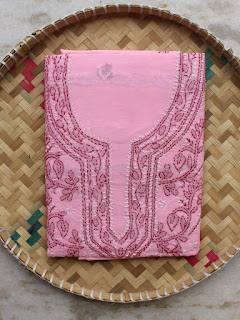
Gota-patti chikankari Dress-material

Summers are here and so are worries related to dressing for summer weddings.


"Chikankaris" have long association with summers. Perhaps since the time of Mughal queen "NurJahan". Mughals and Nawabs of Awads have been patorns of this beautiful handiwork.

Shilphaat.com brings beautiful assemblage of these "Oh-soo-cool" Traditional gota-patti, zari and chikankari Handembroideries on voile-cotton fabrics accompanied with ultra-light crepe dupatta.


Light-pink Gota-patti Chikankari Unstitched 3pc suit

Monday, 29 April 2019

Carrot-Pink Cotton Chikankari 3pc Ladies Suit Set at Shilphaat.com

Carrot-Pink Chikankari Handembroidered, 3pc cotton Ladies Suit Set with chiffon dupatta. 


Carrot-Pink Chikankari Dress-material

Material-  Voile cotton (Cotton Blend) for top and bottom. chiffon for dupatta
Craft- Jaali, Shadow-work, murri Chikankari handembroidery from Lucknow- Uttar Pradesh

Embroidery at Kurta/Top Back

Embroidery on Bottom Fabric
Kurta- 2.83 mts

Bottom- 2.21 meters


Click on link to view details and Shop online: https://www.shilphaat.com/Heavy-Chikankari-Suits/Carrot-Pink-Chikankari-Embroidered-3pc-Ladies-Cotton-Suit-Set-id-3730101.html

www.shilphaat.com

Friday, 26 April 2019

Silk- Linen Sarees

Lightweight, Elegant and comfortable Silk by linen Sari. Linen is a fabric obtained from plant flax or linseed  and is valued for its exceptional properties like light-weight, softness, absorption that keeps skin cool and fresh. 

Pure Mulbarry silk at warp and linen at weft with ghicha silk palla and zari border.

Craft- Handloom woven at Bhagalpur handloom Cluster.

Silk Palla, Yellow And Black Silk Linen Sari


Silk Palla, Green and Blue Handloom Silk-Linen Sari


Ghicha Palla, Handloom Pink Silk Linen Sari


Handloom Silk Palla, Green Silk Linen Sari


or Whatsapp at +91-9818036781 . 

Thursday, 18 April 2019

Daily Wear Chikankari Dress-material


Red Chikan Embroidered, Yellow 3pc cotton Suit

Red Chikan Embroidered, Yellow 3pc cotton Suit


Who says CHIKANKARIS are just heavily embroidered luxury wear kind of things??


Magenta Chikan Embroidered 3pc Cotton Suit

Magenta Chikan Embroidered 3pc Cotton Suit


Presenting lightly embroidered "daily wear kind" of soft cotton chikankari 3pc. unsitched dress-material just for 799/- plus shipping


Khaki-Brown Chikan Embroidered 3pc Cotton dress material

Khaki-Brown Chikan Embroidered 3pc Cotton suit

Blue Chikan Embroidered 3pc Cotton Dress-material

Blue Chikankari 3pc Cotton Suit set


Shop now at www.shilphaat.com 

Category "Unstitched"
Sub-category "chikankari dress-material"


Monday, 8 October 2018

Banchari Folk Music from India


Banchari is a village in Haryana State of North India. The small village is famous for its folk music, song and dance, passed on from one generation to other. Though not much is known about its origin and history
Nagada(huge drum), bin/pungi, janjh/manjira and harmonium are important musical instruments used in it.

Songs are usually in Braj Bhasha(dialect of Hindi), dedicated to Lord Krishna and Radha. 

A Group of Artists perform, younger ones take role of Dancing and singing while older ones are mainly playing musical intruments. 

Artists wear white kurta-payjama with pagdi and matching scarf tied around waiste and flower garland around their neck.

Raising fast track music has effected this folk-art also and left it vulnerable. 
Shilphaat.com is dedicated to bring best of India to the world.

Thursday, 23 August 2018

Chanderi Weaving

Chanderi is a place in Indian State Madhya Pradesh that holds an important place in history
Handloom Zariwork chanderi Sari
of India. Besides holding political importance, Chanderi is also famous for its weaving that emerged around 13th century and its history is incomplete without mention of Chanderi weaving. 


The thin translucent fabric, with undegummed silk at warp and cotton at weft, was favorite among royalties of the time, as it gave relief from heavily woven traditional silk fabrics in soaring temperatures of Madhya Pradesh. 


Use of un-degummed or raw silk yarn at warp or tana give fabric its desired lightness and transparency. However, Due to un-degummed silk warp, the fabric texture is somehow not very soft. Silk of 16/18 to 20/22 Denier count is used
Zariwork handloom dress-material 

Golden, silver and copper shade zari are used for extra warp designs in border and extra weft designs in palla/mundhani/upper-half and body. Once real gold and silver zari were used but now silver and golden threads made of metallic alloy are used. Real gold and silver zari are also used but only on demand.

Weaving is done on pit as well as frame loom fitted with jala designing technique.

As per Handloom Census Data, Number of handlooms are 4352 and 13056 weavers.


Though cheap polyster made imitation chanderis are also available in market, yet original hasn't lost its charm.
Block-printed and handdyed chanderi dress-material
Come induldge in fabric once favoured by royalties. Shop authentic and original chanderis at www.shilphaat.com
click EXQUISITE CHANDERI to shop online at Shilphaat.com

Tuesday, 6 September 2016

Bagru Hand Block Printing

Bagru Block printing
Bagru is a small city near Jaipur, Rajasthan, India, Known for its art of textile printing using natural dyes and handcarved wooden blocks. The tradition of bagru block printing is centuries old and has been kept alive by "Chippa community." Chippa is derived from word chapa which means impression. The community is concentrated in locality kown as "Chippo ka mohalla"

Carving wooden blocks
The process of block printing involves many steps starting from making of blocks. 
Patterns of flora, fauna and geometrical patterns are drawn paper and then traced on flat surfaced wooden pieces. The patterns are then hand-carved with high precision
Trolly with color and blocks
.  Printing single textile involves use of many block, sometimes upto 20 or more. The blocks have to be carved with such detailing and precision that one block fits and complements other to complete a pattern.
Most prominent colours are black, Madder Red, indigo, Yellow and Green. The dyes are prepared with natural things like turmeric for yellow and plant based indigo for blue,. Black is prepared by fermenting iron in jaggery mixture and so on.

Conditioning fabric for Block-printing
The undyed fabric is then soaked in muddy water and then sun dried. The process rids fabric of starch and other impurities and makes it more absorbent for colors too. The dried fabric is then laid on long table and an artist, with a trolly beside him carrying color soaked sponge and blocks, starts printing.
Bagru  is a painstakingly laborious and time taking process. 
One saree may take 2-3 days for printing. Due to the time involved and precision required, most families have moved to 

Awardee Bagru Artist Purshottam Chippa showing his work
Very few families are now involved in bagru handblock printing. Besides, fast and easy screen printing is also posing serious threat to industry. 
Shilphaat.com has brought Bagru block printed textiles from artist Mr. Purshottam Chippa at its store.


Shop Online Handblock -printed 

Dupatta, 

https://www.shilphaat.com/Hand-Block-Printed-catid-1277782-page-1.html

 Dress-material, 

https://www.shilphaat.com/Dress-Material-catid-890013-page-1.html

fabrics 

https://www.shilphaat.com/Precut-Fabric-catid-1184565-page-1.html

and sarees at:

https://www.shilphaat.com/Sarees-catid-1088208-page-1.html


Thursday, 28 April 2016

Mekhela Chador- Assamese Handloom


Cotton Chaddar
Mekhela-Chador/chaddar is the traditional dressing of women of all age group, living in Assam(A state in north-eastern part of India). Mekhela-Chador is also known as Dakhona, Danka, khamlet, Phanek.  It consists of two parts mekhela and chador. Mekhela resembles sarong- a large piece of cloth wrapped around lower part of body and tucked at waist. It is worn over a petticoat or underskirt.  Chador is a wrap or dupatta. It is also a piece of cloth, wrapped around upper part of body, over shoulder.  A set of Mekhela and chador appears to be like a saree in two parts.
As per Third National Handloom Census Of Weavers  And Allied Workers 2010, Assam has largest concentration of  handloom worker households (21.7%) in country. Around 8.74 lakh(38.5%) handloom households produce Mekhla-chaddar, though most for domestic use(62%) rather than for commercial purpose. The North-Eastern states have a predominantly female (99%) adult work force and handloom weaving is part of the culture across all social groups. Major type of looms used in the region are Frame looms (78%) and loin looms (21%).
The yarns used are cotton, eri silk, muga silk and pat silk and their combination. Assam’s handloom industry is basically silk oriented as the climate of Assam is suitable for sericigenous flora and fauna. Fabric is woven in plain or twill weave with check or stripe design and is characterized by a border with extra wrap or weft design. Dying, complex weaving techniques and dense figural decoration are not features usually associated with handlooms of Assam.

References:
1.     Third National Handloom Census Of Weavers And Allied Workers 2010
2.     ARTS &  CRAFTS of North-East  http://ignca.nic.in/craft252.htm#Dyeing


Wednesday, 13 April 2016

Chikankari

Chikankari is the art of hand embroidery practiced in the city of Lucknow(India) and its vicinity. The history of chikan embroidery in India dates back to almost 400 years and is believed to be a Persian craft, that came to India with Noorjahan, the queen of Mughal Emperor Jahangeer. However, Chikankari flourished under the patronage of the Nawabs(rulers) of Awadh(Historical name for Lucknow and its environs).
Chikan embroidery has a repertoire of about 40 stitches of which about 30 are still being used. The main stitches with their traditional names are:

1.    Taipchi: Running stitch worked with six strands of thread on the right side of the fabric. It is usually done within parallel rows to fill petals and leaves . It's considered to be the simplest and the swiftest chikankari stitch  and is used as a basis for further embroidery.
2.    Pechni: In this stitch, taipchi is covered by intertwining the thread over it in a regular manner to provide the effect of something like a lever spring and is always done on the right side on the cloth.
3.    Pashni: Taipchi is worked to outline a motif and then its covered with minute vertical satin stitches over about two threads and is used for fine finish on the inside of badla.
4.    Bakhia: Or Herringbone Stitch also known as shadow-work is a very common chikan stitch, principally done from wrong side of fabric and is of two types:
(a) Ulta Bakhia: A string of criss-cross stitches is made on reverse / wrong side of the fabric underneath the motif. That appears as parllel rows of running stitch from right-side and beautiful shadow of underneath stitches can be seen from transparent fabric .
(b) Sidhi Bakhia: Back stitch with criss-cross Herringbone Stitches of  individual threads. The floats of thread lie on the surface of the fabric. 

5.    Khatao, khatava or katava is cutwork or appliqué - more a technique than a stitch.
6.    Gitti: Stem-stitch , A combination of buttonhole and long satin stitch usually used to make a wheel-like motif.
7.    Janjira: Chain stitch usually used as outlines in combination with a line of pechni or thick taipchi.
8.    Murri: A very minute satin stitch in which a knot is formed over already outlined taipchi stitches.
9.    Phanda: Or knot stitch is a smaller shortened form of murri. The knots are spherical and very small, not pear shaped as in murri. 
Chikankari at Shilphaat.com

10. Jaalis: Or Pulled-thread-work where holes / jaalis or trellises  are made by manipulation of the needle without cutting or drawing of thread. jaalis are created is by pulling apart wrap and weft threads of fabric in a fashion that minute openings are made in the cloth. Shape of openings and the stitches used distinguish one jaali from another.
Traditionally embroidered on muslin with a white thread, but at present all types of fabrics and all colors of threads are. The pattern is block printed on
Block printing 
de-starched fabric or on the semi-stitched garment with fugitive colors, and the embroidery of the garment is then begun. The embroidered piece is then washed, after which the garment is then starched and ironed. The whole cycle can take from one to six months.
Some stitches, in chikan embroidery, are worked from the wrong side of the fabric, while others are worked from the right side as shown in given image. Different specialists work with different types of stitches.